When pieces of bone or cartilage are loose in your hip joint, they can cause painful joint locking and catching. Using a procedure called arthroscopy, your surgeon can remove any loose bodies from your hip. This procedure uses only small incisions and special tools. One of these tools is an arthroscope. This is a small, tube-shaped tool used to look inside your joints.
In the operating room
Just before surgery, you may be asked several times which hip is to be treated. This is a standard safety measure in the operating room. You will likely receive medicine (anesthesia) to make you sleep or make the area numb, or both.
During the procedure
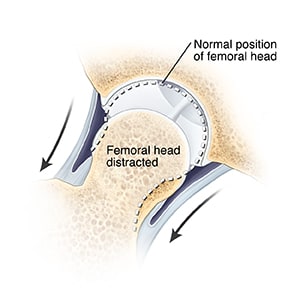
After you receive anesthesia, your leg is gently pulled to widen your hip joint. Next, your surgeon makes a few small incisions called portals. Through these portals, they insert surgical tools, including the arthroscope. The arthroscope sends images of your joint to a video screen. These images allow your surgeon to look inside your joint. The joint is filled with sterile fluid to help your surgeon see more clearly.
Removing loose bodies
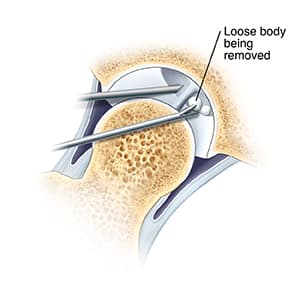
When your surgeon locates the loose bodies in your hip, they will try to remove them using a surgical tool, such as a grasper. But sometimes the loose bodies aren't small enough to be removed. In this case, your surgeon will break down the loose bodies into smaller pieces. Then, the pieces are removed through the portals. Once your surgeon finishes the procedure, the portals are closed and bandaged. Then you are taken to the recovery room.
Online Medical Reviewer: L Renee Watson MSN RN
Online Medical Reviewer: Raymond Turley Jr PA-C
Online Medical Reviewer: Thomas N Joseph MD
Date Last Reviewed: 09/01/2025
© 2000-2026 The StayWell Company, LLC. All rights reserved. This information is not intended as a substitute for professional medical care. Always follow your healthcare professional's instructions.

Related Articles
Upper Arm Fracture Open Reduction and Internal Fixation (ORIF)
Open reduction and internal fixation (ORIF) is a type of surgery used to stabilize and heal a broken bone. You may need this procedure to treat your broken arm. Read on to learn what to expect before, during, and after this surgery.
Hip Arthroscopy: Repairing Femoroacetabular Impingement
When excess bone forms on the edge of the ball or the socket of the hip, it's called FAI (femoroacetabular impingement). This can cause pain and limit movement. Arthroscopy can fix FAI. It uses small incisions and special tools. Read on to learn more.
Foot Surgery: Plantar Fascia Problems
Your plantar fascia is the ligament that extends from the heel of your foot to the ball of your foot. If your foot flattens too much or too little as you move, you may strain your plantar fascia. While the vast majority of people with plantar fascia pain can be helped with nonsurgical treatments, surgery can be considered if these treatments fail.
Treating Ankle Sprains
Learn how to treat ankle sprains.


