Have someone drive you home after you have an endoscopic plantar fasciotomy (EPF). Your health care provider may want you to rest at home for a few days. Ask your provider when you can start walking again. If a compression dressing is used to control swelling, you may need to wear a surgical shoe. You may also need to wear a short leg brace for up to 3 weeks.
Recovering at home
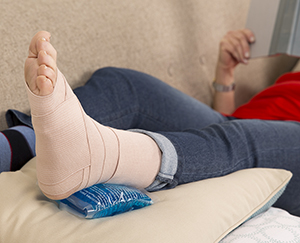
Expect your foot to feel numb right after the surgery. You’ll probably feel some pain after the local anesthesia wears off. Ice your foot for 10 to 15 minutes several times a day to limit pain and swelling. Raise your foot above heart level as often as you can. If you've been given pain medicines, take them as directed.
Your first post-op visit
Your health care provider may want to see you 1 to 2 weeks after surgery. During this post-op visit, your incisions will be checked to make sure they are healing. The compression dressing may be replaced with a smaller surgical dressing. If this occurs, you can probably start wearing sneakers.
When to call your doctor
Call your health care provider if you have:
-
A bandage that is too tight.
-
A lot of swelling or numbness of your toes.
-
Pain not relieved by medicine.
-
More than a few drops of blood at an incision site.
-
Signs of an infection, such as:
-
A fever of 100.4°F (38°C) or higher, or as directed by your provider.
-
Chills.
-
Redness near the incision.
-
-
Skin color changes beyond the dressing.
Featured in
Online Medical Reviewer: Rahul Banerjee MD
Online Medical Reviewer: Stacey Wojcik MBA BSN RN
Date Last Reviewed: 03/01/2025
© 2000-2026 The StayWell Company, LLC. All rights reserved. This information is not intended as a substitute for professional medical care. Always follow your healthcare professional's instructions.

Related Articles
Foot Surgery: Bone Spurs
A bone spur (an extra bone growth) can make walking and wearing shoes painful. There are several nonsurgical treatments for bone spurs. But if these aren't effective, surgery can be considered.
Shoulder Joint Surgery: Bankart Repair
A Bankart lesion is a shoulder injury. It happens when there is a tear in the labrum. This is the fibrous cartilage that helps hold the shoulder joint in place. Surgery can repair this injury.
Upper Body Exercises Before Surgery or Procedure: Help with Walker or Crutch Use
Doing exercises before your knee replacement can help speed your recovery. These exercises build upper body strength. This can help you when you’re using a walker or crutches to get around after surgery. Your physical therapist or surgeon may advise you to use weights to make the exercises more effective. Follow your healthcare provider’s instructions.,
Hip Fracture Surgery: Preparation
After a hip fracture happens, you will likely be taken to a hospital emergency room (ER). While in the ER, many tests will be done, including X-rays and blood tests.


