Low back and leg pain is often because of damage to 1 or more of the disks between the vertebrae. Electrothermal therapy uses heat to change the structure of the tissue inside the disk. It doesn’t relieve pain right away. Pain is reduced as the disk heals. After healing, the disk may also be stronger and more stable than before. This treatment is also called intradiscal electrothermal therapy.
Inside the disk
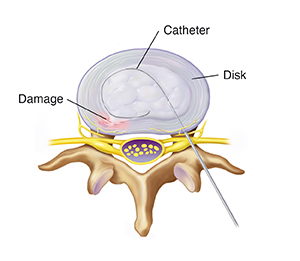
First, a needle is inserted into the disk. Then a special flexible wire (catheter) is threaded through the needle, so that it curves around the inside of the disk. When the catheter is in place, part of it is next to the damage in the disk.
Heating the disk
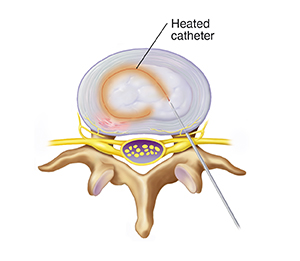
Once the catheter is in place, it's heated slowly to a high temperature. The catheter is kept at that temperature for a few minutes. Then it's removed. The heat may deaden nerves in the disk, preventing these nerves from causing pain. The heat may also make the disk shrink. This may mean that the disk no longer presses on nerves. The heated tissue will slowly heal over the next few months and form scar tissue. This scar tissue may:
-
Plug any leak in the disk
-
Make the disk stronger
Risks and possible complications
The risks and complications of electrothermal catheter therapy include:
-
Bleeding
-
Spinal fluid leak
-
Infection
-
Nerve damage
-
Worsened pain after recovery
-
No improvement of pain
Online Medical Reviewer: Jimmy Moe MD
Online Medical Reviewer: Ronald Karlin MD
Online Medical Reviewer: Tara Novick
Date Last Reviewed: 09/01/2024
© 2000-2026 The StayWell Company, LLC. All rights reserved. This information is not intended as a substitute for professional medical care. Always follow your healthcare professional's instructions.

Related Articles
Treating Osgood-Schlatter Disease
Osgood-Schlatter disease is a condition that affects the knee. It most often affects young, growing teens. Learn details about treatment here.
Laminotomy
Laminotomy is a surgery that takes out a small amount of bone from the spine. This takes pressure off nerves in the low back, which eases symptoms.
Kneecap (Patella) Surgery: Realignment
Some procedures may be done using arthroscopy, a method that uses tiny incisions and special instruments to look and work inside the knee joint. Other procedures need open surgery. The kneecap can be realigned to improve its tracking. To do this, soft tissue may be cut, tightened, or moved.
Upper Arm Fracture Open Reduction and Internal Fixation (ORIF)
Open reduction and internal fixation (ORIF) is a type of surgery used to stabilize and heal a broken bone. You may need this procedure to treat your broken arm. Read on to learn what to expect before, during, and after this surgery.


