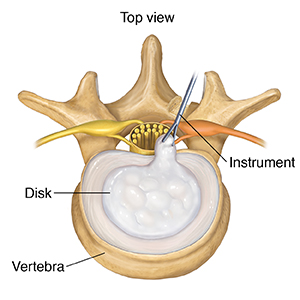
You have a problem caused by a disk in your lower back. This disk problem may be fixed with a diskectomy. This is the surgical removal of a part of a disk. The disk is a cushion found between the vertebrae of your backbone. There are 3 main types of diskectomy. Each has risks and benefits. Generally, this surgery may be an option when conservative treatment has not helped after 6 to 8 weeks or you have muscle weakness, new or worsening neurological problems, or loss of bladder or bowel control. Your surgeon will advise the type that's best for your back and your health:
-
Standard open diskectomy. A cut (incision) is made in the middle of the back. To see and reach the damaged disk, the surgeon then removes some of the ligament and bone material or all of the lamina. Once the disk is exposed, the surgeon removes the part of the disk that's pressing on a nerve, thereby alleviating pain.
-
Microdiskectomy. This surgery is much like the “standard” diskectomy. However, the incision is usually smaller and the surgeon uses an operating microscope or special glasses to magnify, highlight, and view the disk. This is usually done when the symptoms are caused by only one intervertebral disk.
-
Percutaneous or endoscopic diskectomy. This is an outpatient procedure. This means it usually doesn’t need an overnight hospital stay. The surgeon uses X-ray pictures, a small tube with a camera (endoscope), and a video screen to help reach and fix the damaged disk. An open surgical procedure with a larger incision may be required if there are disk herniations at more than one level. This method uses smaller incisions which causes less scarring and a shorter recovery time.
Featured in
Online Medical Reviewer: Heather M Trevino BSN RNC
Online Medical Reviewer: Marianne Fraser MSN RN
Online Medical Reviewer: Vinita Wadhawan Researcher
Date Last Reviewed: 04/01/2024
© 2000-2026 The StayWell Company, LLC. All rights reserved. This information is not intended as a substitute for professional medical care. Always follow your healthcare professional's instructions.

Related Articles
Your Amputation Surgery
Amputation is surgery to remove a limb. Learn about the surgery and what to expect after.
Foot Surgery: Plantar Fascia Problems
Your plantar fascia is the ligament that extends from the heel of your foot to the ball of your foot. If your foot flattens too much or too little as you move, you may strain your plantar fascia. While the vast majority of people with plantar fascia pain can be helped with nonsurgical treatments, surgery can be considered if these treatments fail.
Kneecap (Patella) Surgery: Realignment
Some procedures may be done using arthroscopy, a method that uses tiny incisions and special instruments to look and work inside the knee joint. Other procedures need open surgery. The kneecap can be realigned to improve its tracking. To do this, soft tissue may be cut, tightened, or moved.
Foot Surgery: Flexible and Rigid Hammertoes
With hammertoes, one or more toes curl or bend abnormally. This can be caused by an inherited muscle problem, an abnormal bone length, or poor foot mechanics. There are many nonsurgical treatments for hammertoes, but if these are not effective, you may want to consider surgery.


