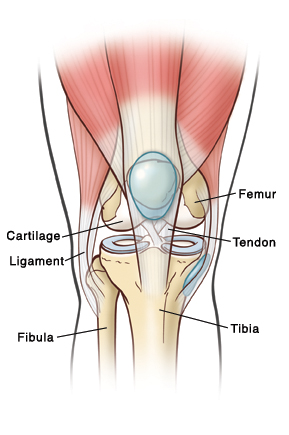
Fluid on the knee is also called knee effusion. The knee joint normally has less than 1 ounce of fluid. Injury or inflammation of the knee joint causes extra fluid to collect there. When this happens, the knee joint looks swollen and is often painful. It may be hard to fully bend the knee.
The most common cause of fluid on the knee is osteoarthritis due to wear and tear on the joint cartilage. Other causes include injury to the cartilage, inflammatory arthritis such as gout or rheumatoid arthritis, and infection of the joint.
If the cause of the fluid is not certain, you may need a needle aspiration. This procedure removes a sample of joint fluid from the knee for testing. Removing excess fluid may also relieve swelling and pain.
Home care
-
Limit your activities. Stay off the injured leg as much as possible until pain improves.
-
Keep your leg elevated to reduce pain and swelling. When sleeping, place a pillow under the injured leg. When sitting, support the injured leg so it's above heart level. This is very important during the first 48 hours.
-
Apply an ice pack over the injured area for 15 to 20 minutes every 3 to 6 hours. Do this for the first 24 to 48 hours. You can make an ice pack by filling a plastic bag that seals at the top with ice cubes and then wrapping it with a thin towel. Continue to use ice packs for relief of pain and swelling as needed. As the ice melts, be careful not to get your wrap, splint, or cast wet. After 48 hours, apply heat (warm shower or warm bath) for 15 to 20 minutes several times a day, or alternate ice and heat. If you have to wear a hook-and-loop knee brace, you can open it to apply the ice pack, or heat, directly to the knee. Never put ice directly on the skin. Always wrap the ice in a towel or other type of cloth.
-
You may use over-the-counter pain medicine to control pain, unless another pain medicine was prescribed. If you have chronic liver or kidney disease, have ever had a stomach ulcer or gastrointestinal bleeding, or take a blood thinner, talk with your health care provider before using these medicines.
-
If crutches or a walker has been recommended, don't put weight on the injured leg until your provider says you can. Check with your provider before returning to sports or full work duties.
-
If you have a hook-and-loop knee brace, you can remove it to bathe and sleep, unless told otherwise.
Follow-up care
Follow up with your health care provider as advised.
If you are overweight, talk to your provider about a weight loss program. The excess weight puts extra strain on your knees.
When to get medical advice
Contact your health care provider right away if you have:
-
Increasing pain, redness, or swelling of the knee.
-
Fever of 100.4°F (38°C) or above, or as advised.
-
Shaking chills.
Online Medical Reviewer: Rahul Banerjee MD
Online Medical Reviewer: Raymond Turley Jr PA-C
Online Medical Reviewer: Stacey Wojcik MBA BSN RN
Date Last Reviewed: 01/01/2025
© 2000-2026 The StayWell Company, LLC. All rights reserved. This information is not intended as a substitute for professional medical care. Always follow your healthcare professional's instructions.

Related Articles
Understanding an Ankle Fracture
When you have an ankle fracture, it means that one or more of the bones in the ankle are broken. Read on to learn about details such as causes, symptoms, and treatment.
Heel Spurs
A heel spur is an overgrowth of bone where the plantar fascia attaches to the heel bone. Read on to learn how to care for yourself if you have a heel spur.
Shoulder Impingement Syndrome
The rotator cuff is a group of muscles and tendons that surround the shoulder joint. These muscles and tendons hold the arm in its joint. They help the shoulder turn. The rotator cuff muscles and tendons can become irritated from repeated rubbing against the shoulder bone. This is called shoulder impingement syndrome or rotator cuff tendonitis.
Thumb Dislocation
How to care for your thumb after you've had a dislocation.