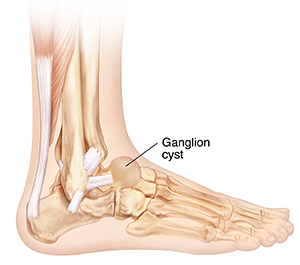
A ganglion cyst is a fluid-filled swelling of the lining of a joint or tendon. Ganglions can form on any part of the foot. But they most often appear on the ankle or top of the foot. They tend to change in size. They may even go away and return later.
Causes
Repeated irritation can make the lining of a joint or tendon weak. This may lead to ganglions. Bony outgrowths (bone spurs) and arthritis may also cause them by irritating the joints and tendons. They can also occur after a foot injury.
Symptoms
Ganglion cysts often form with no symptoms. If ganglions swell, they may put pressure on the nerves and the overlying skin. This can cause tingling, numbness, or pain. Their size can change with different activities or a change in weather.
How are they diagnosed?
Ganglion cysts are sometimes mistaken for tumors. So it’s important to have a complete exam done. Tests may be done to confirm the diagnosis.
Health history
Your healthcare provider will ask you questions. These include how long you’ve had the ganglion. And what kind of symptoms you’re feeling. They may ask if it’s changed in size or if its size varies based on your activities.
Physical exam
Your healthcare provider may do a transillumination exam. This is done by shining a light through the swelling. You can often see through a ganglion. But not through a tumor. When your foot is pressed (palpated), a ganglion feels spongy and the fluid moves from side to side.
Tests
If a bone spur or arthritis is suspected, X-rays may be needed. Fluid removal (needle aspiration) may be done. It also helps to decrease pain. To confirm a ganglion, an MRI scan may be done. This reveals detailed images of soft tissue and bone. Sometimes, special dyes may be injected into the area to show the outline.
How are ganglions treated?
Ganglion cysts may be hard to treat without surgery. But nonsurgical methods may be helpful in relieving some of your symptoms.
Nonsurgical care
-
Pads placed around the ganglion can ease pressure and friction.
-
Fluid removal may also ease symptoms. This is done with a needle. A steroid may be injected at the same time. But ganglions may come back.
-
Limiting movements or activities that increase pain may bring relief.
-
Icing the ganglion for 15 to 20 minutes may relieve inflammation and pain for a short time.
-
If inflammation is bad, your provider may treat your symptoms with medicine.
Surgical treatment
Surgery may be needed if a ganglion is causing ongoing or severe pain. The entire ganglion wall is removed during the procedure. Some nearby tissue may also be removed.
After surgery
You may feel pain, swelling, numbness, or tingling for several weeks following surgery. You should be able to walk soon afterward. But your foot may need to be wrapped or in a cast, boot, or hard shoe. See your provider if you notice any future problems. Surgery is often successful. But there is a chance that the ganglion will come back.
Online Medical Reviewer: Rahul Banerjee MD
Online Medical Reviewer: Raymond Turley Jr PA-C
Online Medical Reviewer: Rita Sather RN
Date Last Reviewed: 04/01/2024
© 2000-2026 The StayWell Company, LLC. All rights reserved. This information is not intended as a substitute for professional medical care. Always follow your healthcare professional's instructions.

Related Articles
Sacroiliitis
Sacroiliitis is when one or both sacroiliac joints are hurt or inflamed. It can make small movements of the lower back and pelvis very painful. Learn how to care for yourself at home.
Bursitis of the Elbow (Olecranon)
Learn how to care for yourself when you have elbow bursitis.
De Quervain Tenosynovitis
De Quervain tenosynovitis is inflammation of tendons and synovium on the thumb side of the wrist. Learn how to care for this condition at home.
Understanding Fifth Metatarsal Fracture
A fifth metatarsal fracture is a type of broken bone in your foot. The fifth metatarsal connects your smallest toe to your ankle. These bones help with arch support and balance.


