Facts about the skin
The skin is the body's largest organ. It covers the entire body. It serves as a protective shield against heat, light, injury, and infection. The skin also:
-
Regulates body temperature.
-
Stores water and fat.
-
Is a sensory organ.
-
Prevents water loss.
-
Prevents entry of bacteria.
-
Acts as a barrier between the body and its environment.
-
Helps to make vitamin D when exposed to the sun.
Your skin takes on different thickness, color, and texture all over your body. For example, your head contains more hair follicles than anywhere else. But the soles of your feet have none. And the soles of your feet and the palms of your hands are much thicker than skin on other areas of your body.
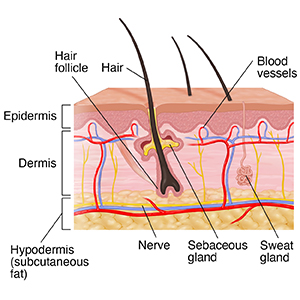
The skin is made up of three layers, called the:
-
Epidermis.
-
Dermis.
-
Subcutaneous fat layer (hypodermis).
Each layer has certain functions.
|
Layer |
What it does |
|
Epidermis |
The epidermis is the thin outer layer of the skin. It consists of two primary types of cells:
|
|
Dermis |
The dermis is the middle layer of the skin. The dermis contains:
The dermis is held together by a protein called collagen. This layer gives skin flexibility and strength. |
|
Subcutaneous fat layer |
The subcutaneous fat layer is the deepest layer of skin. It's made of a network of collagen and fat cells. It helps conserve the body's heat and protects the body from injury by acting as a shock absorber. |
Date Last Reviewed: 09/01/2025
© 2000-2026 The StayWell Company, LLC. All rights reserved. This information is not intended as a substitute for professional medical care. Always follow your healthcare professional's instructions.
Related Articles
Sunscreens: Protect Your Skin
This sheet discusses the effects of ultraviolet light and the increased risk of skin cancer, including the use of sunscreen as one skin cancer prevention method.
What Is Atopic Dermatitis?
This condition causes your skin to be irritated. People with asthma or allergies also often have this condition.
Skin Cancer: Prevention
Detailed information on skin cancer prevention, including protecting children from the sun.
Sunburn (Sun Poisoning)
Most sunburns are minor and go away in a few days. But sunburns can be serious. It's important to know when to get medical care.


