What are the signs of melanoma?
The first sign of melanoma is often a change in a mole, or the appearance of a new mole. The ABCDE rule can help you tell a normal mole from one that might be melanoma. The ABCDE rule is:
- Asymmetry. One half of the mole does not match the other half.
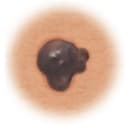
- Border irregularity. The edges of the mole are ragged or irregular.
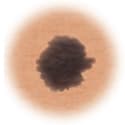
- Color. The mole has different colors in it. It may be tan, brown, black, red, or other colors. Or it may have areas that seem to have lost color.
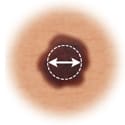
- Diameter. The mole is bigger than 6 millimeters across, about the size of a pencil eraser. But some melanomas can be smaller.
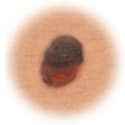
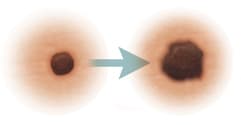
- Evolving. A mole changes in size, shape, or color.
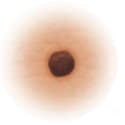
|
Melanoma |
Sign |
Characteristic |
|---|---|---|
|
|
Asymmetry |
When half of the mole does not match the other half |
|
|
Border |
When the borders (edges) of the mole are ragged or irregular |
|
|
Color |
When the mole has more than one color |
|
|
Diameter |
If the mole's diameter is larger than a pencil's eraser |
|
|
Evolving |
When the mole changes in the way it looks over time |
Other signs and symptoms that may be melanoma include:
- A mole that itches or is sore.
- A mole that oozes, bleeds, or becomes crusty.
- A mole that looks different from your other moles.
- A sore that doesn't heal.
- A mole or sore that becomes red or swells at its edges or beyond.
Get to know your moles
Become familiar with the way your moles look so you will know if they're changing. Take note of any new moles that appear on your skin.
When to see your doctor
Most moles are not melanomas. But it's important to see your doctor if you have moles or other spots on your skin with the features above. Also see your doctor if you are worried about a spot on your skin for some other reason. Your doctor will examine the mole and do testing on it to find out if it is cancer.
Featured in
Date Last Reviewed: 09/01/2025
© 2026 The StayWell Company, LLC. All rights reserved. This information is not intended as a substitute for professional medical care. Always follow your healthcare provider's instructions.
Related Articles
Nonmelanoma Skin Cancer: Stages
The stage of a cancer is how much and how far the cancer has spread in your body. It's one of the most important things to know when deciding how to treat the cancer. Here's what you need to know about the stages of nonmelanoma skin cancer.
Nonmelanoma Skin Cancer: Newly Diagnosed
Being told you have skin cancer can be scary, and you may have many questions. But you have people on your care team to help you.
Melanoma: Surgery
Surgery is the most common way to treat melanoma. It might be the only treatment needed for early stage melanomas, and it's often part of the treatment for more advanced cancers.
Melanoma: Stages
Doctors use different systems to measure the thickness of a melanoma and to stage the disease. These systems summarize the extent of your cancer.


