Urinary incontinence is the uncontrolled leakage of urine. Your doctor will discuss your choices for treating your urinary incontinence. These depend on the cause of your problem and any other health issues you have. Often behavioral changes are tried first, followed by various medicines. If these methods don't help, one or more of the therapies described below may be part of your treatment plan.
Biofeedback
Biofeedback uses special sensors to measure muscle contractions that control urination. This method is taught by a nurse or physical therapist. During the therapy, a small sensor is placed in your vagina or near your anus. It's connected to a computer screen and shows on a graph when you use your pelvic floor muscles. Another sensor is placed on your stomach. This finds activity when you use abdominal muscles instead of those on the pelvic floor. Other types of sensors are also available. These sensors read signals from the pelvic floor muscles. When you tighten (contract) or relax your muscles, these signals can be heard as audible tones or seen as images on a computer screen. Using these cues, you can learn to relax or contract certain muscles and tailor your exercise program. This can help you make these muscles stronger and control them better. And it can help you learn pelvic floor muscle exercises.
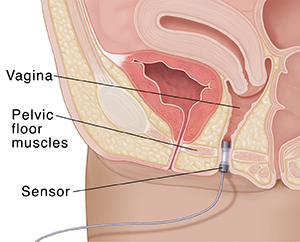
Electrical stimulation
This is a painless therapy that uses a tiny amount of electric current on the nerves that control your bladder. It helps make very weak or damaged pelvic floor muscles stronger. The electric current is sent through the muscles of the pelvic floor and bladder. This causes the muscles to contract. In time, this helps make the muscles stronger.
Stimulator implants
This method is used to treat severe urge incontinence that hasn’t responded to other treatments. A small internal pulse generator device is implanted under the skin near the upper buttocks. This device gives off mild electrical signals to stimulate the sacral nerves that affect bladder function. These block extra signals that are being sent to the bladder muscle. This helps the bladder work more normally.
Featured in
Online Medical Reviewer: Daphne Pierce-Smith RN MSN
Online Medical Reviewer: Melinda Murray Ratini DO
Online Medical Reviewer: Vinita Wadhawan Researcher
Date Last Reviewed: 05/01/2025
© 2000-2026 The StayWell Company, LLC. All rights reserved. This information is not intended as a substitute for professional medical care. Always follow your healthcare professional's instructions.
Related Articles
Pelvic Inflammatory Disease (PID)
Pelvic inflammatory disease or PID is an infection of a woman’s reproductive tract. Scar tissue grows between internal organs leading to ongoing pelvic pain. It can also lead to ectopic pregnancy.
Bartholin’s Cyst: Common Treatments
When the opening of a Bartholin's gland becomes blocked, the gland may swell and form a cyst. Treatment depends on various factors, including the size of the cyst, whether it causes symptoms, and whether it's infected.
What Are Fibrocystic Breasts?
If your breasts ever feel lumpy, sore, or tender, you may have fibrocystic breasts. This is a very common condition. Here's what you need to know about it.
Female Urinary Tract Infections (UTIs)
Learn about female UTIs, including the types of UTIs, the medicines to treat them, and lifestyle changes you can make to treat and prevent them.


