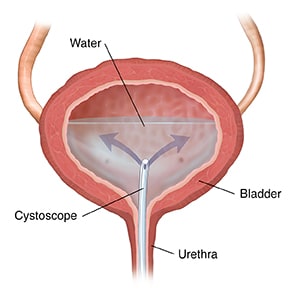
Hydrodistention is a procedure that fills up your bladder with water. It is used to help find out what may be causing your bladder pain. During the procedure, a long, thin tube (cystoscope) is used. It has a lens and a light on one end. This tube helps your doctor see inside your bladder. It is put into your bladder through your urethra. That's the tube that passes urine out of your body.
How to say it
Say "HY-droh-dihs-TEN-shun sis-TAW-skuh-pee."
Why hydrodistention with cystoscopy is done
This procedure is done to figure out the cause of bladder pain. It may help diagnose bladder pain syndrome (BPS), also called interstitial cystitis (IC). If you have this health problem, you may feel pain when your bladder fills with urine. You may also need to pass urine more often.
This procedure is also sometimes done to treat BPS. It may be tried if other treatments, such as medicine, don't work.
How hydrodistention with cystoscopy is done
This may be done in a hospital or at an outpatient facility. During the procedure:
- You are given medicine so you won't feel any pain. It may also make you fall asleep.
- The doctor puts the cystoscope into your urethra. The scope is gently moved forward into your bladder.
- Using the cystoscope, your bladder is slowly filled with as much water as possible. This helps find out how much fluid your bladder can hold.
- Your bladder is then drained and filled again.
- Your doctor may look at your bladder lining with the cystoscope. They will see if there are any sores or other possible causes for your symptoms.
- Your bladder is drained.
Risks of hydrodistention with cystoscopy
All procedures have risks. Some possible risks of this procedure include:
- Infection.
- Blood in urine.
- Symptoms getting worse.
Author: Semko, Laura
Online Medical Reviewer: Donna Freeborn PhD CNM FNP
Online Medical Reviewer: Marc Greenstein MD
Online Medical Reviewer: Raymond Kent Turley BSN MSN RN
Date Last Reviewed: 07/01/2023
© 2000-2026 The StayWell Company, LLC. All rights reserved. This information is not intended as a substitute for professional medical care. Always follow your healthcare professional's instructions.
Related Articles
Treating Interstitial Cystitis: Special Therapies and Surgery
Learn about the different types of treatment available to help manage interstitial cystitis.
Ureteral Stricture Surgery (Ureteroplasty)
Ureteroplasty is surgery to remove a narrowing (stricture) in the ureter. Learn what to expect with this procedure.
Partial Cystectomy
Partial cystectomy is surgery to remove part of the bladder. It is most often done to treat bladder cancer. After the surgery, the bladder will still function. Here's what you can expect before, during, and after the procedure, including your recovery in the hospital and at home.
Incontinent Urinary Diversion
Urinary diversion is surgery that makes a new way for urine to pass out of the body. It may be needed if the bladder is diseased or damaged. It may also be done if another problem in the body keeps the bladder from working correctly. Learn how the surgery is done.


