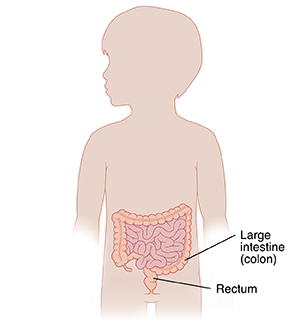
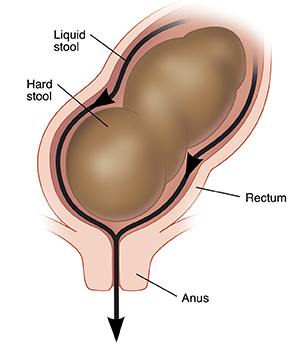
Your child has uncontrolled leakage of poop (stool) from the opening where poop leaves the body (anus). This is called encopresis. The leakage is caused by the backup of dry, hard poop (constipation). Hard poop piles up at the end of the rectum. This is where poop is stored before leaving through the anus. The lower colon and rectum may become stretched out. In time, liquid poop leaks out from around the blockage. This leakage often happens without your child’s knowing it. Your child may not even feel the need to poop.
What are the symptoms of encopresis?
Symptoms of encopresis may include:
-
Liquid poop leaking onto the underwear.
-
Having gas along with poop leaking.
-
Pain around or under the belly button.
-
No feeling of having to pass poop before leakage happens.
-
Belly swelling or bloating.
What causes encopresis?
Encopresis is caused by frequent or long-term constipation. Some causes of constipation that may lead to encopresis include:
-
The child holding back poop. This may happen for several reasons. These include a past painful poop, emotional stress, resistance to toilet training, or another reason.
-
Hirschsprung’s disease. This is a birth defect in which nerves in the large intestine (colon) are missing.
-
The anus being closer to the vagina or penis than normal.
-
Problems with the spinal cord, such as an injury or tumor.
-
Cerebral palsy.
-
Diseases that affect the muscles of the pelvic floor or anal sphincter.
How is encopresis diagnosed?
The doctor will ask about your child’s symptoms. They'll give your child a physical exam. Your child may have blood tests to check for other problems. Other tests may include:
-
Digital rectal exam. For this test, the doctor inserts a gloved finger into the anus to check for problems.
-
Nervous system exam. This can help rule out a problem with the spinal cord.
-
Abdominal X-ray. This can look for stool stuck in the rectum.
-
Anorectal manometry. This test studies the nerves and muscles of the anus and rectum.
-
Barium enema. This is a type of X-ray to check the lower gastrointestinal tract. The child's rectum is filled with a liquid containing barium. The doctor watches the flow of the barium on a screen to see if any parts of the tract are too narrow.
How is encopresis treated?
The first step in treatment is to remove any hard stool stuck in the colon. Your child may need medicines such as laxatives, suppositories, or enemas.
Preventing constipation and building healthy bowel habits are important parts of treatment. They can help prevent future problems with encopresis. For example:
-
Your child may need to drink more water, get more fiber in their diet, and get regular exercise.
-
Medicines such as stool softeners and laxatives may help.
-
Your child may have bowel retraining. This process can help your child have normal bowel movements. This will include having set times to sit on the toilet, such as after meals. Be sure to praise and reward your child when they follow the routine.
Try to be patient. It can take 4 to 6 months or longer before encopresis goes away.
Therapy can help some children. In some cases, emotional issues may have added to the problem.
Featured in

Related Articles
Food Poisoning (Infant/Toddler)
Dehydration is the main concern when a child has food poisoning. This sheet can help you care for your sick child at home.
When Your Child Has Constipation
Constipation is a common problem in children. Your child has constipation if their poop is hard and dry. This often leads to straining or trouble pooping. Read on to learn more about symptoms and treatment.
When Your Child Has Diarrhea
Diarrhea is one of the most common illnesses in children. It can lead to too much fluid loss (dehydration) which can be serious. So preventing dehydration is important in managing your child's diarrhea. Here's what you need to know.
When Your Child Has a Gastric or Duodenal Ulcer
An ulcer is a breakdown of tissue on the inside of the stomach or small intestine. This causes a sore to form. Learn more about what to do when your child has an ulcer in the stomach (gastric ulcer) or in the first part of the small intestine (duodenal ulcer).