Hands are made up of more bones and moving parts than most other areas of the body. When they’re healthy, these parts all work together. They do a large number of tasks. Hands can make very delicate movements. They can also do tasks that need great strength.
-
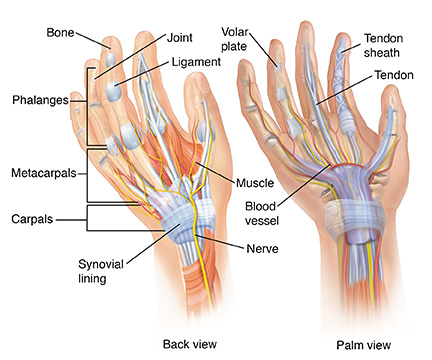
Bones. These are hard tissues that give your hand shape and stability.
-
Phalanges. These are the finger bones.
-
Metacarpals. These are the middle part of the hand bones.
-
Carpals. These are the wrist bones.
-
Joints. These are places where bones fit together, allowing movement.
-
Ligaments. These are soft tissues that connect bone to bone and stabilize your joints.
-
Muscles. These are soft tissues that tighten and relax to move your hand.
-
Synovial lining. This makes the fluid inside your joints that helps make movement smooth.
-
Volar plates. These are hard tissues that stabilize the joints, keeping fingers from bending backward.
-
Tendon sheaths. These are fluid-filled tubes that surround, protect, and guide the tendons.
-
Tendons. These are cord-like soft tissues that connect muscle to bone.
-
Blood vessels. These carry blood to and from your hand.
-
Nerves. These send and receive messages, allowing you to feel and direct movement.
-
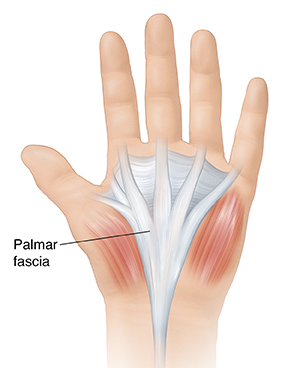
Palmar fascia. This is a firm layer of soft tissue that stabilizes the palm of your hand.
Online Medical Reviewer: Marianne Fraser MSN RN
Online Medical Reviewer: Rita Sather RN
Online Medical Reviewer: Stacey Wojcik MBA BSN RN
Date Last Reviewed: 08/01/2023
© 2000-2026 The StayWell Company, LLC. All rights reserved. This information is not intended as a substitute for professional medical care. Always follow your healthcare professional's instructions.

Related Articles
What Are Mallet, Hammer, and Claw Toes?
Mallet, hammer, and claw toes are among the most common foot problems. They are often caused by wearing shoes that are too short or heels that are too high.
The Shoulder Joint
The shoulder is made up of bones, muscles, ligaments, and tendons. Learning about the parts of the shoulder joint will help you to understand your shoulder problem.
Your Neck Muscles
Illustration and explanation of neck muscles.
Anatomy of the Sacroiliac Joint
Learn the anatomy of the sacroiliac joint.


