A ganglion is a swelling (cyst) that forms on joint and tendon sheaths. They are most often found in the wrist. But they can also show up at any joint including on the foot, fingers, or toes. Ganglia are believed to be caused by a rupture of the tissue that lines the joints and tendon sheaths (synovial tissue).
nonsurgical methods may help ease some of your symptoms although sometimes surgery is needed.
Nonsurgical care
Nonsurgical methods are:
-
Placing pads around the ganglion, to ease pressure and friction.
-
Removing the fluid, to ease symptoms. But ganglia may come back. The gelatinous gel is removed through a large-bore needle. You may get a steroid injection after the cyst fluid is removed.
-
Limiting movements or activities that increase pain, to bring relief.
-
Icing the ganglion for
15 to 20 minutes, to temporarily help with inflammation and pain. -
Taking medicine. If your inflammation is severe, your healthcare provider may treat your symptoms with medicine.
Surgery
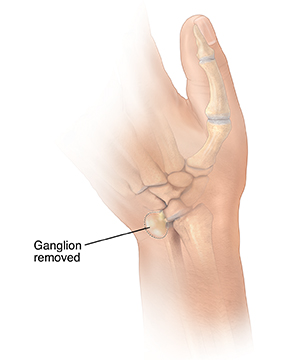
If a ganglion is causing ongoing or severe pain, you may need surgery. Your surgeon removes the whole ganglion wall during the procedure. They may also remove some nearby tissue. If the ganglion has come through a tear in the capsule of the joint, the tear may have to be repaired. The joint will likely be protected while the tear heals.
After surgery
You may feel pain, swelling, numbness, or tingling for some weeks after surgery. See your healthcare provider if you notice any problems in the future. Although surgery is often successful, there is a chance that the ganglion will come back even after surgery.
Online Medical Reviewer: Joseph, Thomas N., MD
Online Medical Reviewer: Sather, Rita, RN
Date Last Reviewed: 09/01/2025
© 2000-2026 The StayWell Company, LLC. All rights reserved. This information is not intended as a substitute for professional medical care. Always follow your healthcare professional's instructions.

Related Articles
Hip Arthroscopy: Repairing Synovitis and Arthritis
Arthroscopy can be used to repair synovitis and arthritis.
Treating Bunions
Bunions don't go away. Wearing shoes that fit correctly will often relieve the pain. Learn about how choose the right shoes and about other ways to treat bunions.
Hip Arthroscopy: Repairing Chondral Damage
Arthroscopy can be used to repair loose or missing cartilage in the hip joint. Learn more about this surgery and how it is done.
Understanding Surgical Repair of Skier’s Thumb
Skier's thumb is an injury to the ligament at the base of your thumb. This surgery is to repair or reconstruct the ligament and restore function.


