Wrist arthroscopy is used for diagnosis and treatment. It works best for showing ligament tears, damage to the triangular fibrocartilage complex (TFCC), or joint cartilage. Since the wrist is a very small joint, the surgeon uses a special arthroscope.
Ligament tears
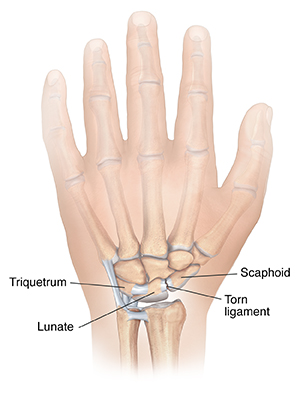
The ligaments between the bones of the wrist can tear. This most often happens between the lunate and scaphoid bones or the lunate and triquetrum bones. Such tears can cause pain, swelling, and a weak grip. With a full tear, the bones may pull apart and limit motion. To perform repairs, your surgeon may shift to open surgery.
TFCC damage
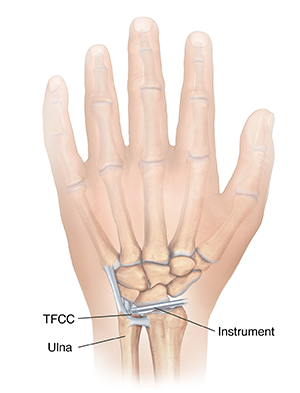
Injury or constant use over time can cause a tear in the TFCC (triangular fibrocartilage complex). During surgery, the tear may be shaved off or repaired. Bone or cartilage fragments may be removed. After healing, you should be able to move your wrist with greater ease and less pain.
Cartilage damage
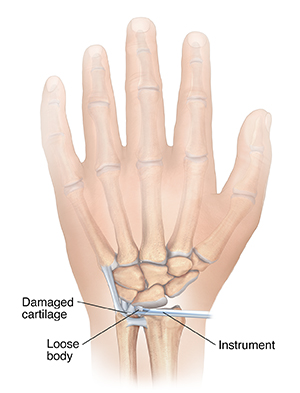
If you have wearing down of the cartilage (arthritis), your surgeon will shave off or smooth the worn area. Bone or cartilage fragments that have chipped off in the joint (loose bodies) will be removed. The removal of loose bodies can help restore smooth, pain-free wrist movement.
Online Medical Reviewer: L Renee Watson MSN RN
Online Medical Reviewer: Raymond Turley Jr PA-C
Online Medical Reviewer: Thomas N Joseph MD
Date Last Reviewed: 12/01/2022
© 2000-2026 The StayWell Company, LLC. All rights reserved. This information is not intended as a substitute for professional medical care. Always follow your healthcare professional's instructions.

Related Articles
Treating Ankle Sprains
Learn how to treat ankle sprains.
Kneecap Surgery: Removing Damaged Cartilage
Surgery may be used when pain severely limits your activities. Or it may be done when a rehab program or other nonsurgical treatments just are not helping enough. Some procedures may be done using arthroscopy. This method uses tiny incisions and special instruments to look and work inside the knee joint. Other procedures need open surgery.
Upper Arm Fracture Open Reduction and Internal Fixation (ORIF)
Open reduction and internal fixation (ORIF) is a type of surgery used to stabilize and heal a broken bone. You may need this procedure to treat your broken arm. Read on to learn what to expect before, during, and after this surgery.
Understanding Clavicle Fracture Open Reduction and Internal Fixation (ORIF)
Open reduction and internal fixation (ORIF) is a type of treatment to fix a broken bone. It puts the pieces of a broken bone back together so they can heal.


